

Last Updated on June 17, 2026 by Blake Turner
Imagine you’re deep in the wilderness, with no phone signal and the trail disappearing behind you. How do you find your way back safely?
Mastering basic navigation techniques with a map and compass is your key to staying confident and secure in any outdoor adventure. You’ll discover simple, practical skills that anyone can learn—skills that could make all the difference when you need them most.
Ready to take control of your journey and never feel lost again? Keep reading, and you’ll gain the knowledge to navigate like a pro.

Credit: www.youtube.com
Essential Map Features
Learning to navigate with a map and compass is a useful skill. Knowing the essential features of a map helps you find your way.
Maps show the terrain, directions, and distances. Understanding these features keeps you on track during outdoor adventures.
Reading Contour Lines
Contour lines show the elevation and shape of the land. They help you see hills, valleys, and flat areas.
Lines close together mean steep terrain. Lines far apart show flat ground. Pay attention to these lines to know what to expect.
Identifying Symbols And Legends
Maps use symbols to represent features like rivers, roads, and forests. The legend explains what each symbol means.
Check the legend before starting your journey. This helps you understand the map and locate important landmarks.
- Trees may be shown as green triangles
- Rivers might appear as blue lines
- Buildings could be marked as squares
Understanding Scale And Distance
Scale shows the ratio between map distance and real distance. It helps you measure how far you need to travel.
A map with a scale of 1:50,000 means 1 unit on the map equals 50,000 units in reality. Use a ruler to measure the distance on the map.
| Map Scale | Real Distance |
| 1:25,000 | 1 inch = 25,000 inches |
| 1:50,000 | 1 inch = 50,000 inches |

Credit: map-skills-moors-and-dales.co.uk
Compass Basics
A compass is a tool that shows direction. It helps you find your way on land or water.
Using a map and compass together makes navigation easier and more accurate.
Parts Of A Compass
A compass has several parts that work together to show direction. Knowing these parts helps you use it right.
- Baseplate:The flat part you hold and place on the map.
- Magnetic Needle:The needle that points to magnetic north.
- Compass Housing:The rotating circle with degree marks.
- Direction of Travel Arrow:Shows which way to go.
- Orienting Arrow:Used to align the compass with the map.
Taking And Following Bearings
A bearing is the direction from one point to another. You use a compass to find or follow a bearing.
To take a bearing, point the compass at your target and read the number on the dial. To follow a bearing, turn your body until the needle lines up with the orienting arrow.
- Hold the compass flat in your hand.
- Point the direction arrow at your target.
- Turn the compass housing until the orienting arrow matches the needle.
- Read the bearing number at the direction arrow.
- To follow, keep the needle and orienting arrow aligned as you move.
Adjusting For Declination
Declination is the difference between magnetic north and true north. It changes depending on where you are.
You must adjust your compass for declination to get an accurate direction on a map.
- Find the local declination value on your map.
- If declination is east, subtract it from your compass reading.
- If declination is west, add it to your compass reading.
- Some compasses let you set declination on the dial.
- Adjusting declination helps match compass and map directions.
Combining Map And Compass
Using a map and compass together helps you find your way outdoors. You can see where you are and where you want to go.
These tools work best when you learn how to use them at the same time. This guide shows you how.
Orienting The Map
Orienting the map means turning it to match the real world. This helps you understand directions on the map.
Use your compass to find north. Then turn the map until its north points the same way.
- Place the compass flat on the map.
- Rotate the map and compass together.
- Match the compass needle with the map’s north.
Plotting Your Position
Plotting your position means finding where you are on the map. This helps you plan your route.
Look for landmarks like rivers, roads, or hills near you. Match these with the map features.
- Identify nearby landmarks.
- Find the same landmarks on the map.
- Mark your position where the landmarks meet.
Navigating To A Destination
Use the map and compass to move toward your goal. This keeps you on the right path.
First, set your compass to the direction from your position to the destination. Then follow that bearing.
- Place the compass edge between your position and destination on the map.
- Turn the compass dial to align with the map’s north.
- Hold the compass flat and turn your body until the needle points north.
- Walk in the direction the compass points.
Practical Navigation Tips
Knowing how to use a map and compass is very helpful when you go outdoors. These tools help you find your way even in unknown places.
Using simple navigation tips can keep you on track. Learning these skills makes your outdoor trips safer and more fun.
Using Landmarks
Landmarks are natural or man-made features you can see from far away. They help you know your location on the map.
Look for tall trees, hills, buildings, or rivers. Check these against your map to stay on the right path.
- Pick clear and easy-to-spot landmarks
- Use more than one landmark to confirm your place
- Keep landmarks in sight as you move forward
Estimating Travel Time
Knowing how long it takes to travel helps you plan better. It prevents you from getting lost or caught in the dark.
Use your walking speed and distance on the map to guess travel time. Add extra time for rough paths or breaks.
- Average walking speed is about 3 miles or 5 kilometers per hour
- Slow down on hills or uneven ground
- Take short rests to stay fresh
Staying Safe Outdoors
Safety is very important when using a map and compass. Always tell someone where you are going before you leave.
Carry extra supplies like water, food, and a first aid kit. Check the weather and dress properly for your trip.
- Bring a whistle or phone for emergencies
- Stay on marked trails to avoid getting lost
- Watch your surroundings and stay alert
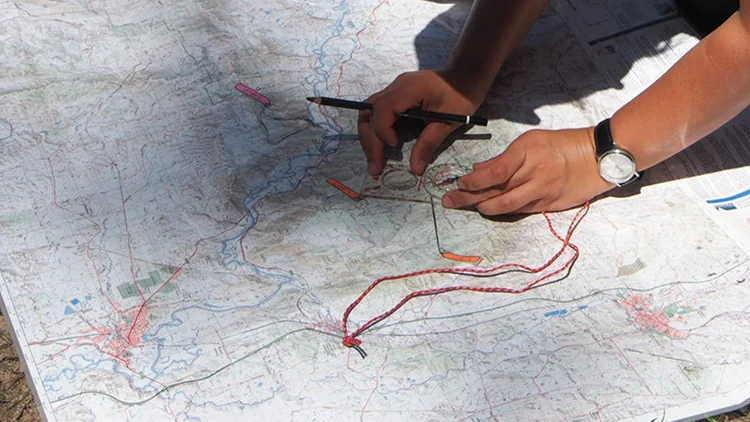
Credit: www.unleashed-unlimited.com.au
Frequently Asked Questions
What Are The Basic Tools Needed For Map And Compass Navigation?
A map and a compass are the main tools needed for basic navigation outdoors.
How Do I Orient A Map Using A Compass?
Align the compass needle with the map’s north to match map and ground directions.
How Can I Find My Direction Using A Compass?
Point the compass needle north, then turn the dial to set your travel direction.
What Is Triangulation In Map And Compass Navigation?
Triangulation uses bearings from three landmarks to pinpoint your exact location on a map.
How Often Should I Check My Position While Navigating?
Check your position regularly to stay on course and avoid getting lost.
Conclusion
Using a map and compass keeps you safe outdoors. Practice these basic skills often. They help you find your way without technology. Trust your tools and stay calm. These simple techniques work in many places. Start with easy routes, then try harder ones.
Soon, navigation will feel natural and clear. Remember, good preparation makes adventures fun. Keep learning and exploring with confidence. Your map and compass are your best guides.